

INAUGURAL SPEECH
Aimé Césaire's inaugural speech
Place du 22 Mai, Trénelle — 22 May 1971
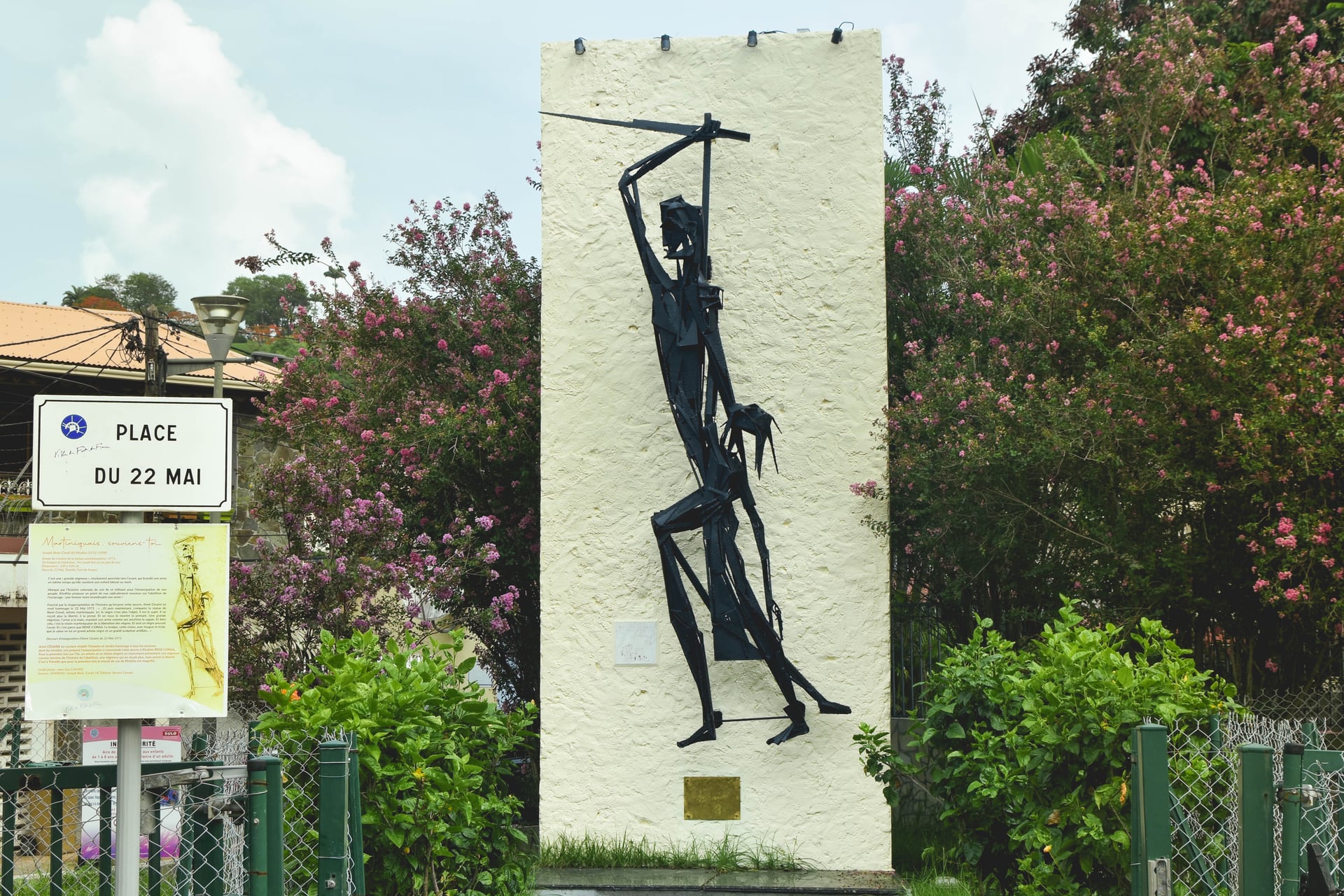
Speech delivered by Aimé Césaire, member of parliament and mayor of Fort-de-France, at the solemn inauguration of Place du 22 Mai in Trénelle and the unveiling of Khokho RENÉ-CORAIL's statue “Martinican, remember”, on 22 May 1971.
Source: Édouard de Lépine, Aimé Césaire, écrits politiques, 1957-1971, Nouvelles éditions Jean-Michel Place, 2016.
“Schœlcher, French philanthropist, liberator of the Negroes”
“Schœlcher, French philanthropist, liberator of the Negroes.” I can well imagine this dictionary definition, which would have delighted governments and prefects. And indeed, this sentence sums up rather well the official Schœlcher — more precisely, the Schœlcher of official Schœlcherism.
For, as you know, for some time now, and in order to outflank the parties of the left who had gone to dig Schœlcher out of the dusty attic where the princes of the Third and Fourth Republics had relegated him, the officials of the Fifth Republic — true impostors — have set off again to conquer Schœlcher, and they celebrate Schœlcher in their own way: that is, without the people, of course, but with prefects, generals and admirals.
Well, that Schœlcher is not ours, and I owe it to the truth to say that he bears only a very distant relation to the real Schœlcher.
As for the real Schœlcher, if we could question him today about his true role in the history of the abolition of slavery, I can well imagine his answer: that, without disowning his own action, without passing over the episodes of his struggle, he would have taken great care not to keep silent about the role of those fighters of shadow and night — the Maroons and the rebel Negroes.
“Four, five Negro insurrections”
It is Schœlcher himself who notes it. Let us listen to Schœlcher:
“Never do ten years pass without the Negroes protesting through some act of violence against the condition in which they are kept. Look at Martinique alone, and without going back further than 1811.
In 1811: revolt
In 1822: revolt
In 1823: revolt
In 1831: revolt — the general conspiracy, breaking out to the cry of liberty or death!
In thirty years, four, five Negro insurrections.”
Well, these figures are not some banal statistic, of a kind to satisfy minds merely curious about history. On the contrary, they establish a point that is capital to our debate and illustrate a fundamental philosophical and sociological truth. For the formulation of that truth, I could turn to Karl Marx or to Lenin.
For the occasion, I would rather ask Victor Schœlcher. So let us listen to Victor Schœlcher:
“Ever since men have lived in society, the oppressed have never obtained anything from the oppressors except by force; and if every step in the career of the world's freedom is marked with blood, that is a necessity which must be acknowledged with me, but for which one can blame only the impotence or the malice of providence.”
But then, you will say to me, 1848?
But then, you will say to me, 1848? Did 1848 not constitute the divine surprise, the divine exception to that law of iron and blood? And to speak of 1848 — is that not precisely to evoke a particularly auspicious era when, by an unheard-of stroke of fortune, men of conscience, awakening a whole nation to the beauty of altruistic feelings, obtained from it the repeal of an iniquitous colonial regime? Which would have spared our people a violent action and saved Martinican society a bloodbath?
Well, no!
In colonial history there is room neither for the idyll nor for the bucolic, nor for the nights of the 4th of August, nor for vain love affairs; and Schœlcher is right to say and to think that, even in the best of cases, it is still and always violence that is the midwife of history.
And that is why, despite the decree of 4 March 1848, despite the decree of 27 April 1848, there still had to be a 22 May 1848.
The facts are known
In February 1848, a revolution breaks out in Paris and overthrows the monarchy of Louis-Philippe. A provisional government is formed, which Victor Schœlcher joins, and one of the first acts of the government thus formed is to decide on the establishment of an ad hoc commission to prepare the abolition of slavery. That is the decree of 4 March 1848.
The commission sets to work and, on 27 April, still at Schœlcher's instigation, obtains from the government the publication of a second decree: the decree of 27 April, which states in its Article 1:
“Slavery shall be entirely abolished in all French colonies and possessions two months after the promulgation of the present decree in each of them.”
So, you will say to me, everything was settled. Well, no. Nothing was settled.
Still two more months to wait. What am I saying? Three months, perhaps four.
Reckon it well: the time for the decree to reach the colonies and be promulgated takes a month; so that brings us to the end of May or the beginning of June. Two months after that brings us to the month of August.
And that is exactly what the planters wanted. They scarcely hid it: there was a harvest to bring in, and one last service had to be wrung from the servile workforce. Such was the calculation, and Schœlcher makes no mystery of it:
“All the planters gathered in Paris,” he writes, “begged the Commission to postpone final abolition at least until July, so as to give the harvest, they said, time to be completed.”
Wait until July? Wait until August? And then, who knows? Who knows whether, taking advantage of events, the emancipation measure taken in a moment of euphoria or of general panic might not be reversed?
One must believe this was not badly reasoned, since, as early as May 1848, the Republic turns to reaction, and you know the terrible massacres of workers perpetrated by General Cavaignac, which made the June days of 1848 in Paris a kind of dress rehearsal for the massacres of the Bloody Week that marked the end of the Paris Commune, some 23 years later.
And so one may well ask what, in such circumstances, and in such an atmosphere of frenzied reaction, would have become of the emancipation law. For my part, I have good reason to believe it would have been treated as a dead letter, if not purely and simply repealed.
That alone is enough to legitimise our ancestors' entrance onto a stage to which they had not been invited, in May 1848.
Spontaneity of the masses? Not at all. But sure revolutionary instinct.
“Be patient,” they were told
Be that as it may, from the very decree of 27 April, a rain of advice pours down on the wretched slaves.
They had waited two centuries. And all that advice rang with the same sound, repeating to satiety the same leitmotiv: one must wait, one must be patient.
“Be patient,” Minister Arago had told them.
“Be patient,” Perrinon repeated to them, in terms — it must be said — rather inane: “To the Negroes, we recommend trust in the Whites. To the latter, trust in the Negroes; to all classes, trust in the government. Patience, hope, union, order and work — that is what I recommend to you.”
Patience above all, and most of all, insisted the unspeakable Husson, Director of the Interior in Martinique:
“You have surely learned the good news that has just arrived from France. It is quite true. Freedom is coming. It is good masters who asked for it on your behalf. But the Republic must be given the time to make the law of freedom. So, nothing has changed for now. You remain slaves until the law is promulgated. My friends, have trust and patience.”
But the Negroes of Martinique decided otherwise. They had waited two centuries. They swore not to wait a second longer. And, on 22 May, came the insurrection.
On 22 May 1848, in Saint-Pierre, the enslaved population rises up, occupies the town, sets fire to the Désabaye plantation, and wages bloody fighting in the course of which 35 people lose their lives…
Governor Rostoland, this time, understands; and so came the order of 23 May 1848:
Article 1: Slavery is abolished from this day in Martinique.
“A freedom wrested through high struggle”
Well, Martinican women and men, this is the event we are celebrating today and which René-Corail's moving statue commemorates: a freedom not granted, but wrested through high struggle; an emancipation not conceded, but conquered — and which teaches everyone, and first of all Martinicans themselves, that if it is true that Martinique is a speck of dust, there are nonetheless specks of dust inhabited by people who fully deserve the name of human beings. And that certainty, you see, is one of those that authorise us to look at the present with greater firmness and to face the future with greater audacity.
And now, look at René-Corail's statue: it is a woman, a Black woman — perhaps Martinique herself — who, supporting her wounded child with one hand (perhaps her dead child), brandishes a weapon with the other: she does not weep, she fights.
“Here, the Negro is no longer the object, he is the subject”
Look, and remember the other statues of liberty that you have seen and that commemorate the same event. Recall the statue of Schœlcher that stands before the Courthouse of Fort-de-France: a young girl whose chains have just fallen, blowing a kiss of gratitude to her liberator, Victor Schœlcher, who, with one hand, wraps her in a great paternal gesture full of kindness and, with the other, shows her the way.
The work is rather beautiful. But mark the inspiration: it is the work of a white man*.
And then there is another statue: a bronze of rather fine workmanship belonging to the town hall of Fort-de-France. It represents a Negro twisted with pain whose chains France, in a violent gesture, has just broken and whose fragments she brandishes victoriously.
A declamatory work, perhaps, but not without power. But here again, mark the inspiration: it is the work of a white man and, in its way, to the glory of the white liberator.
And now, compare René-Corail's statue, the work of a Martinican artist.
Here, the Negro is no longer the object, he is the subject.
He no longer receives freedom. He takes it, and we are shown him taking it.
A great Black woman, weapon in hand, wielding her weapon as her ancestors wielded the assegai.
Well, that is the Martinican vision of the liberation of the Negroes. And only a Negro could have had it. And it is because René-Corail rendered that vision with fire and brilliance that I salute in him a great Negro artist and a great Caribbean sculptor.
Place du 22 Mai and rue Gérard-Nouvet
Martinican women and men,
We are scarcely accustomed, at the municipality of Fort-de-France, to inaugurations. Had we needed to hold them, we would have had to multiply them, and that would have taken much of your time and attention. That is why I take advantage of the inauguration of René-Corail's statue to bring to your attention two decisions of your municipal council; two decisions which, as the law requires, will take effect within a fortnight.
The first is to give the square in which we now stand the name Place du 22 Mai.
The second — and I ask you to pay attention to this — is to give to a street that leads to this square, coming from Trénelle, the name Gérard Nouvet, the young high-school student, a martyr, who fell under police bullets or grenades during Messmer's visit.
What connection, you will ask me, with 22 May 1848? What connection with Victor Schœlcher?
Well, I say it plainly:
Gérard Nouvet henceforth takes his place in the long martyrology of our people, alongside the Martinican women and men who fell over the centuries, victims of colonialism and of police sadism.
And since, to avenge him, there is a whole youth, there is, to accuse the executioners — today as yesterday — the voice of Victor Schœlcher:
Let us listen to him once more:
“Towards the masses as towards individuals, the best way to win hearts is persuasion. From the wound of a governmental bayonet springs a source of vengeance. Shame and a curse upon those who forget it.”
May Terrade hear! May Terrade understand!
Three streets, three symbols
Martinican men and women: here we stand before this statue of Martinican liberty.
See where it is placed: at the meeting point of three streets:
— at the end of rue Jean-Jacques Rousseau
— at the end of boulevard Patrice-Lumumba
— at the end of rue Gérard-Nouvet
Three streets, three symbols:
Jean-Jacques Rousseau: revolutionary thought.
Patrice Lumumba: anticolonialist revolutionary action.
Gérard Nouvet: martyred youth, victim of colonialist abuses.
And it is true that all these paths — honest, and therefore revolutionary, thought; courageous action; the innocent martyr — sum up all the innocent suffering of a people.
All of this leads to a single point: freedom. Martinican freedom.
It is therefore on this square, at this point of convergence, that it befits us more than ever to cry out, on this 22 May 1971, with all our faith and all our certainty:
“Long live Martinique!”
* Here Aimé Césaire contrasts the statue of Victor Schœlcher, made by a Westerner, with that of Khokho RENÉ-CORAIL, a Martinican artist.
Aimé Césaire, in Édouard de Lépine, Aimé Césaire, écrits politiques, 1957-1971, Nouvelles éditions Jean-Michel Place, 2016.